

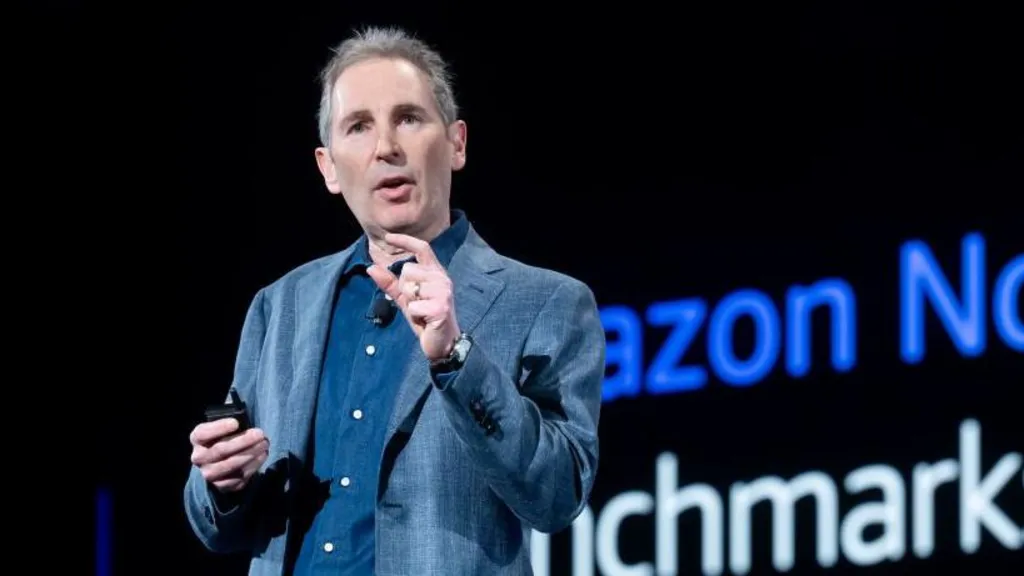

Amazon CEO Andy Jassy has urged employees to embrace artificial intelligence (AI), while cautioning that the technology will likely result in a reduced corporate workforce over the coming years.
In a staff memo sent on Tuesday, Jassy encouraged employees to “be curious about AI” as the company ramps up its use of the technology. He noted that AI is expected to drive significant “efficiency gains,” which will enable Amazon to streamline operations and lower headcount.
The announcement positions Amazon among a growing list of companies outlining their AI strategies amid global concerns over job displacement caused by automation.
“We will need fewer people doing some of the jobs that are being done today, and more people doing other types of jobs,” he wrote. “It’s hard to know exactly where this nets out over time, but in the next few years, we expect that this will reduce our total corporate workforce as we get efficiency gains from using AI extensively across the company.”
Companies – particularly in the tech industry – have been pouring resources into artificial intelligence, driven by rapid advancements that now allow chatbots to generate code, text, and images with minimal input.
However, as these tools become more widely adopted, concerns around job displacement are growing. Industry leaders have warned that AI could significantly impact entry-level white-collar roles.
Last month, Dario Amodei, CEO of AI firm Anthropic, told Axios that AI could potentially eliminate half of all entry-level office jobs. Geoffrey Hinton, often referred to as the “Godfather of AI” for his pioneering work at Google and beyond, echoed similar concerns during a recent podcast appearance.
“This is a very different kind of technology,” he said, pushing back against arguments that job losses from AI will be outweighed as the technology creates new kinds of positions, in a pattern seen with earlier technological leaps. “If it can do all mundane human intellectual labor, then what new jobs is it going to create? You’d have to be very skilled to have a job that it couldn’t just do.”
As of the end of last year, Amazon employed over 1.5 million people globally, making it one of the world’s largest employers.
The majority of its workforce is based in the United States, where Amazon stands as the second-largest employer, behind only Walmart.
While a significant portion of employees work in e-commerce warehouse operations, around 350,000 are in corporate and office-based roles, which could be most affected by the company’s shift toward AI-driven efficiencies.
Quick Take
Amazon’s push toward AI-driven efficiency reflects a broader shift where large enterprises are openly preparing for workforce reductions—especially in white-collar roles—as a strategic outcome of automation. By framing it as “efficiency gains,” Amazon signals that AI adoption isn’t just about innovation—it’s about restructuring. With 350,000 corporate roles potentially in scope, this move may set a precedent for how other tech giants recalibrate their human capital strategy in the AI era. The real challenge ahead will be in balancing technological progress with responsible workforce transition.